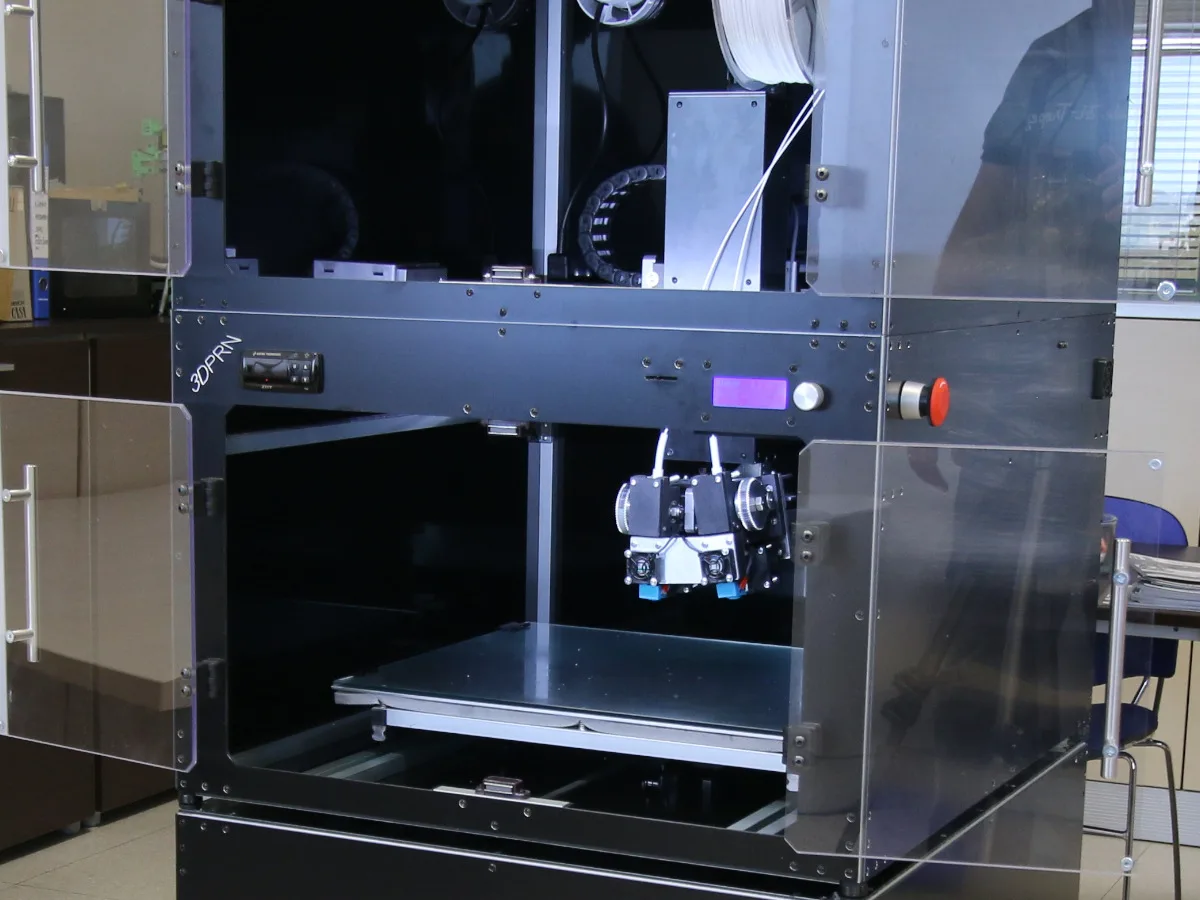
Large-format professional 3D printers have become an increasingly attractive tool for manufacturing companies looking to streamline their design, prototyping, and production processes. The ability to produce large components directly from a digital model eliminates several intermediate steps and offers greater flexibility, speed, and design freedom .
In the industrial sector, however, choosing a large-scale 3D printer isn’t simply about selecting the machine with the largest print volume. A professional solution must meet specific needs regarding precision, productivity, reliability, materials, ease of use, and operating costs .
Large-scale additive manufacturing can be used to create industrial prototypes, technical models, tools, jigs, functional components, and small production runs. To understand its potential, it’s important to understand the key features to consider before integrating this technology into a production process.
What is a large-format professional 3D printer?
A large-format professional 3D printer is an additive manufacturing system designed to produce objects whose size exceeds the capabilities of conventional 3D printers.
Its main feature is the large build volume , which allows you to make large components in one piece or reduce the number of sections needed to complete an object.
This capability can be particularly useful for manufacturing companies working with bulky components. In some projects, producing a component in a single piece reduces the number of subsequent assembly operations and the number of joints.
However, it’s not always necessary to produce the entire object at once. Modular manufacturing allows you to break a model into different parts, designed to be assembled later. This strategy can facilitate transportation, handling, and optimize printing times.
Why use 3D printing in a manufacturing company?
The integration of industrial 3D printing can bring benefits at various stages of the production process. One of the most important is the ability to rapidly transform a digital design into a physical object.
During product development, for example, a company may create an initial prototype, verify its dimensions and functionality, make changes to the CAD file, and produce a new version.
This process allows you to speed up the various validation phases and can help reduce development times.
Key applications include:
- Large-scale industrial prototypes .
- Models to check shapes and proportions.
- Models and production tools .
- Custom tools.
- Functional parts.
- Components for small productions.
- Models intended for assembly tests.
- Custom elements.
- Technical models.
- Components with complex geometries.
The ability to produce directly from a digital file offers greater adaptability to project changes.
Print volume isn’t everything
One of the most common mistakes when evaluating a large-scale 3D printer is to focus exclusively on the maximum dimensions it can produce.
Print volume is important, but it must be analyzed alongside other parameters. A machine can offer high production capacity and yet be unsuitable for a particular project if it doesn’t allow for the use of the necessary material or doesn’t offer the required precision.
Before choosing a professional system, it is advisable to analyze:
- Maximum piece dimensions .
- Precision and repeatability.
- Compatible materials.
- Production speed.
- Operating temperature.
- Extrusion system.
- Stability of the structure.
- Ease of maintenance.
- Preparing the software and files.
- Cost per piece.
The goal should be to find a balanced combination of capacity, performance, and reliability .
The importance of precision
Dimensional accuracy becomes especially important when working with large components.
A small deviation in a small component may have little impact, while in a large component the variations can accumulate and compromise assembly or operation.
Accuracy depends on several factors, including the machine structure, handling systems, thermal stability, extrusion quality, and the parameters used during production. It’s also important to consider the component’s geometry. Correct orientation and proper layer configuration can help control certain deformations and improve the stability of the final product.
For this reason, it is important for a manufacturing company to value not only print resolution , but also the ability to maintain consistent results during prolonged processes.
Productivity and production speed
Productivity is another essential element for the industrial environment.
A large-format professional 3D printer can produce components that, with conventional methods, would require different operations and tools. But for this advantage to be truly significant, the process must be efficient.
Print speed is important, but it shouldn’t be considered in isolation. Excessive speed can negatively impact some aspects of quality, while overly conservative settings can unnecessarily increase production times.
Actual productivity depends on factors such as:
- Time needed to prepare the file.
- Deposition rate .
- Production volume.
- Material consumption.
- Machine setup time.
- Reliability during prolonged printing.
- Need support.
- Subsequent operations.
A good setup should strike a balance between speed, quality, and stability .
What materials can a professional 3D printer use?
Material selection is crucial in any additive manufacturing application. For manufacturing companies, this choice must be made taking into account the component’s expected performance characteristics.
Thermoplastics are widely used in large-format additive manufacturing systems. Depending on the technology and machine configuration, materials with different properties can be used.
Common options include:
- PLA , used in numerous models and prototypes.
- ABS, used in certain technical applications.
- PETG, suitable for various types of components.
- Polycarbonate for applications requiring specific characteristics.
- Polyamides for technical components.
- Fiber-reinforced materials .
- Composite materials intended for more demanding applications.
The choice must always be based on the required properties, such as mechanical strength, stiffness, flexibility, thermal stability or surface finish.
Composite materials for demanding applications
Composite materials can expand the possibilities of professional 3D printing. In some formulations, the incorporation of fibers can improve some of the material’s mechanical properties.
Carbon fiber-reinforced materials, for example, can be used in applications where a combination of stiffness and low weight is desirable . However, these materials may require specific processing conditions. The machine, extrusion system, temperatures, and production parameters must be compatible with the selected material.
For this reason, before investing in a professional 3D printer, a company should check which technical materials it will actually be able to use and what conditions are necessary for their processing.
Large prototypes in one piece
One of the most important advantages of large-format 3D printing is the ability to produce large components without having to divide them into numerous sections.
This can be particularly useful for prototypes, where it’s important to evaluate the entire component. By reducing the number of joints, you can also minimize some subsequent operations.
However, producing a large component requires careful planning. Process duration, component stability, adhesion to the build surface, and thermal behavior must all be carefully considered.
When size or geometry dictates, modular manufacturing can offer a more efficient alternative.
Modular production and design optimization
Dividing a large piece into different modules can be an effective strategy to improve the production process.
The various parts can be designed taking into account the dimensions of the machine and then assembled. Joining systems can be integrated directly into the CAD model , facilitating component placement.
Modular production also offers advantages when it comes to modifications. If a specific section needs updating, in some cases it will be sufficient to rebuild just that module.
This capability can help reduce the time and cost of iterations during product development.
CAD design is a fundamental part of the process
The quality of a printed part doesn’t depend solely on the machine. CAD design plays a fundamental role. A properly prepared model can help reduce material consumption, improve stability, and reduce the need for support structures.
When manufacturing large components, it is also possible to study lightweight internal structures, optimised thicknesses and joining systems specifically designed for additive manufacturing.
The additive manufacturing design concept allows you to exploit the possibilities of 3D printing right from the early stages of the project.
Reliability for industrial work
A manufacturing company needs its equipment to function reliably, especially when a component takes many hours to produce.
Large-format printing can represent a significant investment in time and materials . If the process is interrupted towards the end, the loss can be considerable.
For this reason, reliability and repeatability are essential aspects of a professional 3D printer. Mechanical stability, thermal control, proper material feeding, and process monitoring all contribute to more consistent results.
Reliability is also linked to maintenance. A machine used intensively must be able to be maintained and serviced in an organized manner to ensure its proper long-term operation.
Professional large-format 3D printing and 3DPRN
In the field of professional large-format additive manufacturing , 3DPRN is associated with solutions designed for the production of large components.
For a manufacturing company, choosing a solution should always begin with an analysis of actual needs. Part size, materials, precision, expected productivity, and frequency of use are some of the factors that must be evaluated.
The most suitable solution is not necessarily the machine with the highest print volume, but the one that offers the best balance between size, performance, materials, precision and reliability .
What costs need to be considered?
The purchase price of a professional 3D printer is just one of the elements to analyze.
To evaluate the feasibility of an investment, it’s also important to consider the total cost of production . This can include materials, energy consumption, maintenance, file preparation, labor, and subsequent operations. A machine with a higher initial investment may be attractive if it increases productivity, reduces production times, and reduces the costs associated with some traditional phases.
Therefore, the comparison should be made taking into account the unit cost and the return on investment , not just the initial price of the equipment.
Applications of 3D printing in the manufacturing industry
The versatility of additive manufacturing allows 3D printing to be used in a variety of business areas.
In addition to prototyping, it can be used to produce custom tools, assembly fixtures, jigs, supports and components intended for small production runs .
This technology is particularly interesting when the quantities required are small or when each piece must be adapted to specific conditions.
It can also be useful for rapidly developing internal solutions to improve specific production processes. A company can design a specific tool, produce it using 3D printing, and test its functionality without having to wait for lengthy production times.
How to choose a professional large-format 3D printer
The selection process should begin with the company’s specific needs. Before purchasing equipment, it’s advisable to define the type of components to be produced, their size, and the performance they will provide.
It is also important to consider the frequency of use and the possibility of expanding the machine’s applications in the future.
An adequate assessment should include:
- Required print volume .
- Materials that will be used.
- Precision required.
- Desired productivity.
- Complexity of the pieces.
- Level of automation.
- Ease of maintenance.
- operating costs.
- Future growth potential.
This analysis allows us to avoid making a choice based exclusively on maximum production dimensions.
The future of 3D printing in business
The evolution of industrial 3D printing indicates a trend towards increasingly faster, more automated, and digitally connected processes.
Large-format machines can play an important role in this transformation because they enable additive manufacturing to be applied to components that were previously beyond the reach of conventional systems.
The combination of CAD software, automation, new materials, and additive manufacturing will enable the development of more flexible processes tailored to the needs of each company.
In the future, 3D printing could be further integrated into production lines, not only as a prototyping tool, but also as a complementary technology for the production of components, tools, and small batches.
The professional large-format 3D printer for manufacturing companies represents a solution capable of offering significant advantages in terms of flexibility, customization and speed.
However, making the right choice requires analyzing much more than just the maximum print volume. Accuracy, productivity, reliability, materials, CAD design, and operating costs are all factors that must be considered together.
The ability to produce prototypes and large-scale components directly from a digital model reduces process steps and facilitates modifications during development.
With proper planning, large-format additive manufacturing can become a strategic tool for manufacturing companies looking to modernize their processes and respond more quickly to market demands. The evolution of technologies and materials will continue to expand its applications, making professional 3D printing an increasingly important component of future manufacturing.


